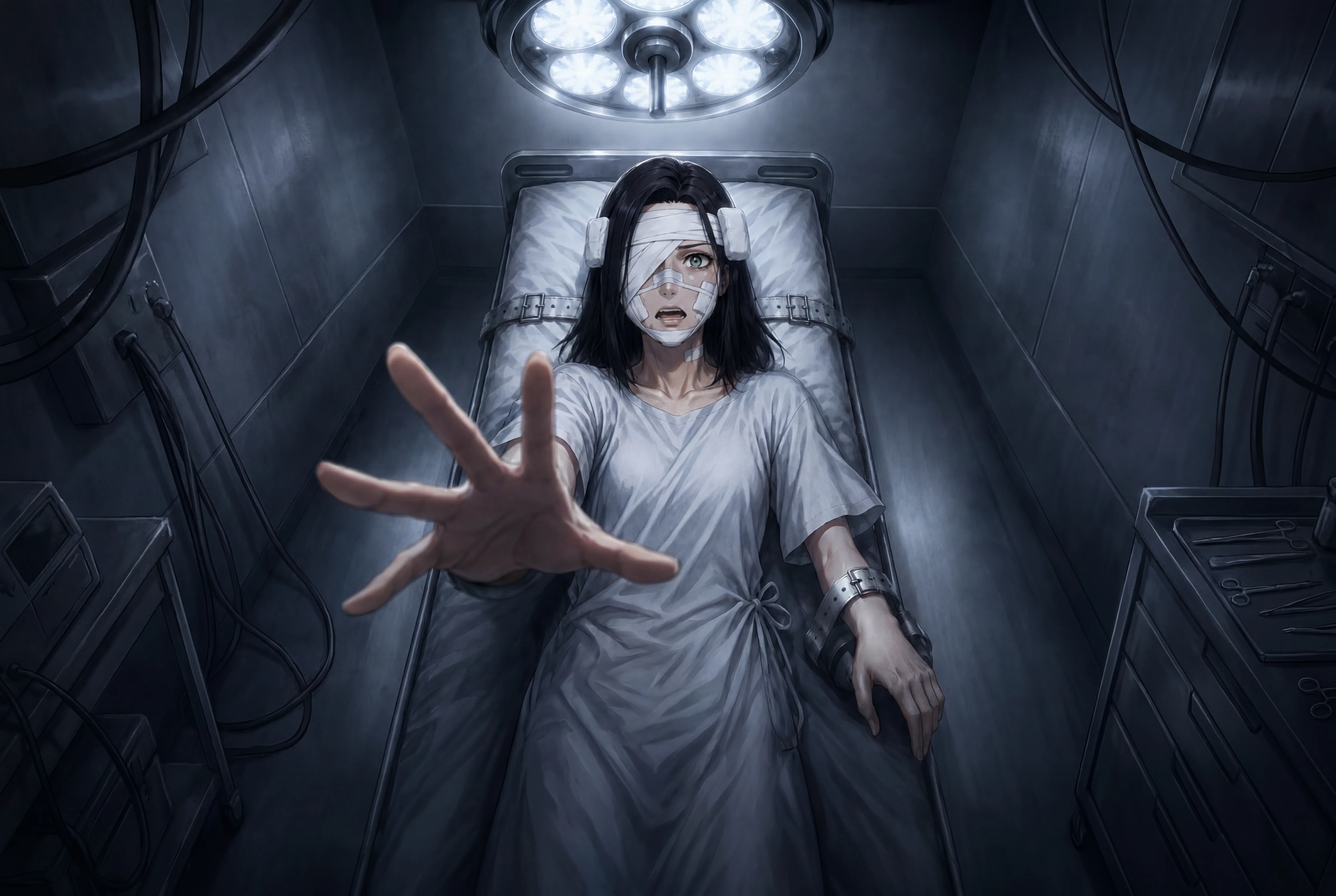
An in-character interview. Elise Navarro is a fictional character in ReelSaga's "The Surgeon Who Stole My Face." Her answers were written by ReelSaga's editorial team, in her voice, fixed to one morning in the story. No real person is quoted.
Elise Navarro has not slept in thirty-one hours, and on this particular date that is normal. Fifteen years ago tonight her sister Isabela walked into New York and never came back out of it, and Elise has not slept through a November 12th since. No body, no suspects, no answers — a fifteen-year cold case that is also the reason she joined the Bureau. This is what an obsession thriller looks like from the side of it that carries a badge: a kitchen table, a lamp, one file read ten thousand times, and fifteen Novembers.
The Surgeon Who Stole My Face is the medical thriller short drama on ReelSaga about an FBI forensic psychologist hunting a surgeon who abducts women and remakes their faces into the face of his dead fiancée. What is different about this November is that at 2:47 a.m. her phone rang, and by dawn she was on the fourth floor of Lenox Hill Hospital taking a statement from a young woman who had climbed a barbed-wire fence to get away from a man nobody can put a name to yet. We sat down with her in the corridor outside the room, twenty minutes after the survivor inside it stopped talking. She was holding a cup of coffee she never drank. What follows is an obsession thriller told, for once, from the chair on the correct side of the table.
What is The Surgeon Who Stole My Face about?
For sixteen years, a surgeon has been abducting young models and operating on their faces without their consent, working from a single photograph of Margot Sinclair — the fiancée he lost, and the face he has been trying to rebuild ever since. He does not call the women victims. He calls them subjects, and Episode 1 belongs to one of them: Sophia Brennan, twenty-two, who wakes strapped to a bed in a windowless white room with soft piano coming out of the walls and a face that moves wrong. Episode 2 belongs to Elise, at her kitchen table, on the anniversary. By Episode 3 the two women are in the same hospital room, and Sophia takes one look at the stranger who came to save her and asks whether she is Margot. Three episodes in, and the obsession thriller has not raised its voice once.
It is an obsession thriller with two obsessives in it, and only one of them has committed a crime. That is the series' real subject. It is also worth saying plainly before you press play: this is an obsession thriller that deals directly with abduction and non-consensual surgery. It never plays either for shock, and it is still not a light watch.
This conversation stops where Episode 3 stops. Elise has a survivor's statement, a first name and nothing else — no surname for Margot, no name for the man, and no idea yet how far back any of this goes.
If you have been looking for shows like The Fall, this is your next obsession thriller: another senior woman investigator handed a case that has produced no suspects, another offender who chooses by type rather than by opportunity, and a profiler thriller just as interested in how calm he is as in how close she gets.
Watch the The Surgeon Who Stole My Face trailer
The white room, the piano, and a profiler reading a file she has read ten thousand times. This is what an obsession thriller sounds like when nobody raises their voice. No jump scares in it — and there are none in the series either.
What did the survivor at Lenox Hill tell Elise Navarro?
InterviewerYou have been awake for thirty-one hours. What was the first thing you wrote down in there?
EliseTwo words of French. He calls them mon cœur — my heart. A man abducts a woman, operates on her face while she is unconscious, and the endearment is the part he never thinks to hide. That tells me he is not hiding from himself either. He believes he is in a love story.
InterviewerShe also said he called her Margot.
EliseRepeatedly. And he showed her a photograph of the woman he wants her to be, which means he has carried that photograph in his coat for sixteen years. I have a first name and a face. Fifteen years of my own looking never produced either.
InterviewerSophia Brennan gave you nearly two hours this morning. What did that cost her?
EliseMore than anyone on that floor understands. She went back into that room in her own head so I could take notes, and she did it while she still cannot look at her own reflection. Everything we know about him, we know because a twenty-two-year-old decided to say it out loud to a stranger. I told her she had done incredibly well. I knew it was not enough while I was saying it.
InterviewerDominic Holt rang you at 2:47 in the morning. Why you?
EliseBecause he has read what I write. We worked a serial arsonist in Boston two years ago who killed seven people, and the profile that closed the box around him was mine. Dominic is methodical in a way I am not — he builds a case brick by brick and he does not guess. He rings me when the brick he needs is inside somebody's head.
Why has Elise Navarro spent fifteen years on one missing person?
InterviewerYour instructors at the Academy thought you were too intense, too focused, too damaged to be objective. Fifteen years on, were they wrong?
EliseThey were right about the first two. \[pause\] Seventeen murderers are in prison because of profiles I wrote, and every one of those profiles was written by a woman who cannot stop thinking about one man she has never met. You do not get the results without the thing that produces them. People would like both. There is only ever one.
InterviewerThe detective who caught Isabela's case retired without a single lead. You built an entire career on top of his empty file. Some people would call that grief with a badge on it.
EliseMorrison did everything the job allowed him to do. The job was not enough. So I went and learned the part of it nobody was doing — why a man takes a young woman off a street and erases her completely, and what he does with her afterwards. That is not a hobby, it is a discipline, and it is the reason I could read this scene in four seconds this morning. Call it grief if you want. I would rather be accused of that than be the sister who let the file close.
InterviewerWhat is the detail in her file you have never been able to put down?
EliseHer handbag turned up in a dumpster three blocks from where she was last seen, and one shoe came out of the Hudson two weeks later. That is the entire physical record of a twenty-three-year-old woman, and the case was cold inside eighteen months. \[pause\] She used to tell me she was going to be famous. One day everyone is going to know my name, Ellie. Nobody knows it. I am the only person left who says it out loud.
InterviewerIs there a version of you who goes home at six?
EliseShe got fifteen years of sleep and a grave to visit. I do not have either of those things.
What an obsession thriller looks like from the profiler's chair
She answers this one without looking up.
InterviewerYou said something in the briefing that stopped the room. That he does not want to hurt them.
EliseNot physically. Not until they fail him. The restraints are padded so they will not bruise. The dosages are exact. Even the music is chosen. He has built a room in which nothing hurts, and a woman still comes out of it no longer being herself. He is erasing these women and replacing them with somebody else, and the fact that he does it gently does not make it less monstrous. Write that down exactly the way I said it.
InterviewerIs he insane?
EliseNo. He is obsessive, and those are different things. Delusional offenders are disorganised and reactive; they make mistakes because they cannot help themselves. This man has run a hidden surgical facility for sixteen years without a single one of my colleagues noticing. Soundproofing, climate control, exact dosages, a camera that never blinks. He knows precisely what he is doing, and he has known it every day for sixteen years. That is the part I need people to stop softening, because softening it is how he has stayed in business.
InterviewerYou told the room he has done this before. How do you know that already?
EliseBecause Sophia looked into a room that had been used and then cleaned, and there was a rectangle of fresher paint on the wall where a photograph used to hang. That is a man tidying up after a subject who did not work out. Sixteen years, a photograph carried in a coat pocket, and a process that has clearly been refined by practice. He is patient and he is controlled, and when a woman fails him he starts again. I would like to be wrong about that last sentence. I am not.
InterviewerAnd the photograph in his coat?
EliseA loss he refused to accept. He could not put her down, so he found a way to keep making her. \[pause\] I am aware of how that sounds coming from a woman who has carried a photograph of her sister for fifteen years. The difference is what the two of us do about it, and I intend to keep that difference.
What does Elise Navarro do if she finds him?
InterviewerOne easy one, because you have earned it. What is the state of your kitchen?
EliseA table, a lamp, a corkboard, and a coffee machine I have never once heard finish. Everything else in that apartment is dark, because I have never needed the rest of the apartment. Dominic rings at 2:47 in the morning and has never asked whether he woke me. That is the entire friendship.
InterviewerHe said he knew you would be awake.
EliseHe always says that. He is always right. One of these nights I would like to be asleep purely to inconvenience him.
InterviewerSophia says he told her Margot was taken from him. Not that she left. Not that she died. Taken.
EliseThat is the most interesting thing she said all morning, and it is the grammar that gives it away. Somebody else acted. Which means Margot may not be the woman he lost so much as the first woman he — I know exactly what I think happened to her, and I am not saying it in a hospital corridor before I can put it in front of a prosecutor.
InterviewerThere are still women out there.
EliseAt least two. One of those rooms had been used and then scrubbed, and one door was locked from the outside, and Sophia could not carry the woman she did find. She has had to live with that since yesterday evening and she should not have to. Beyond that this is an open federal investigation and I am not going to narrate it standing up in a corridor.
InterviewerIf he is as controlled as you say, what makes a man like that move next?
EliseBeing interrupted. He has just lost a subject to a highway and a barbed-wire fence, which by his own account has never happened to him before, and men who have never been contradicted do not respond to it by going quiet. He will need to prove that it was an accident rather than a failure. That is the shape of the mistake I am waiting for.
InterviewerLast one. Anything you would want said to the people who are about to watch a man like this be taken seriously?
EliseDo not call him a monster and stop there. Monsters are comforting, because a monster is not one of us and there is nothing to look for. Look instead for a man with immaculate manners who is extremely good at his job and has never in his life been told no. He will be the most reasonable person in any room he walks into. That is not a coincidence. It is the whole method.
InterviewerThen one more, and it is the one I came for. Do you want to catch him, or do you still want to find her?
EliseNext question.
InterviewerThat was the last one.
\[she stands. the door.\]
How to watch The Surgeon Who Stole My Face
The Surgeon Who Stole My Face is streaming now on ReelSaga — ten animated episodes, one to three minutes each, an obsession thriller cut for a vertical screen. Download ReelSaga and start at Episode 1, "The White Room." Episode 2 is the one with the kitchen table.
Frequently Asked Questions
Is the Elise Navarro interview real?
No. Elise Navarro is a fictional character in The Surgeon Who Stole My Face, and the transcript above was written by ReelSaga's editorial team in her voice and fixed to one morning early in the story. Nobody sat for it. ReelSaga's short dramas are animated fiction and have no cast or creators to quote.
Where should I start with The Surgeon Who Stole My Face?
Episode 1, "The White Room." All ten episodes of The Surgeon Who Stole My Face are animated and streaming now on ReelSaga at one to three minutes each, so the whole obsession thriller is a single sitting.
Is The Surgeon Who Stole My Face based on a true story?
No. The Surgeon Who Stole My Face is entirely fictional — Étienne Lacroix, Margot Sinclair, Sophia Brennan and Elise Navarro are invented characters, and no real case, investigation or person is depicted. The series does deal directly with abduction and non-consensual surgery, which makes it the darkest obsession thriller in the ReelSaga catalogue and not a light watch.
More cases worth staying up for
- — a different hunt, a colder city
- How ReelSaga builds a ten-episode thriller for a vertical screen
- Eyes of the Storm: Yuna on the Secret Twin She Has Never Met
The trailer, the episode drops and every new ReelSaga obsession thriller land here first — we will be up anyway.